Content Automation Risks and Quality Control Frameworks
Risk and content type should determine how much automation you use.
September 24, 2026
Content teams have already settled the AI debate. Ahrefs found that 74.2% of newly created web pages include AI-generated content and just 2.5% is output with no person involved. The rest is some mix of AI drafting and a person's touch. The field is now doing the work, even if some teams are still behind.
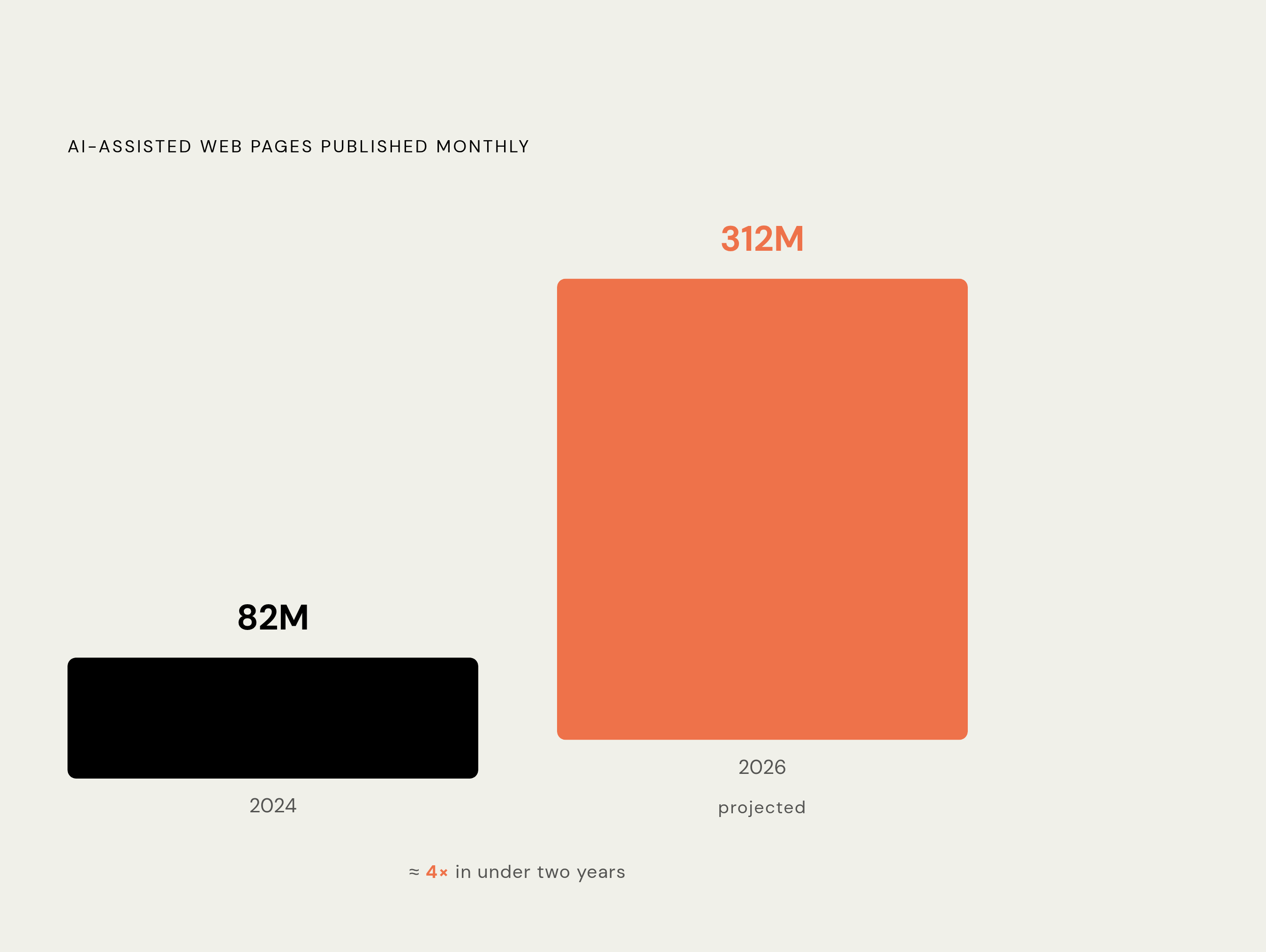
That trajectory makes it tough to dismiss as a phase. The projection puts 312 million AI-assisted web pages going live each month in 2026, a steep rise from 82 million in 2024, and a jump like that shows how quickly the "normal content production" baseline has grown. A separate signal shows the same shift: of the content marketers surveyed, 97% expect AI to help with 2026 content marketing. These stats aren't pointing to a decision the industry still gets to make. They show the space the field already occupies.
What really matters is the kind of automation used, how it's governed, which content it targets, and the quality standard it must meet. Framed like that, both extremes everyone is gravitating toward collapse under their own logic. Automate it all, and quality erodes together with the distinctiveness that gave the content its value. Refuse to skip automation altogether, and a rival using the same software without the same ethical limits gobbles up the customers that quicker output and cheaper runs would have captured.
Both approaches fall apart when content fails in practice. A product FAQ and a financial disclosure are not the same category of risk just because both get filed under "content," and treating them identically, whether that means blanket automation or blanket suspicion, wastes effort in one direction and invites real damage in the other. Risk scales with the kind of content, the harm a mistake could cause, and where it goes. A policy that matches its effort to those variables does what it should. One that won’t is just paperwork, and it will break where the stakes are greatest: on content that can cause real damage if it goes out bad.
Why automation makes sense, plus the objection worth hearing
The arithmetic is simple. The average cost per 2,000-word article has dropped, falling to $268 from $480, and that shift matters most to small companies operating on genuine financial constraints instead of venture runway. McKinsey ranks marketing among the biggest pools for AI deployment, with McKinsey estimates AI’s annual impact potential at $2.6–$4.4 trillion across the economy, with marketing productivity gains valued at $463 billion yearly. 54% of B2B marketers say they're unable to carry out every item their plan demands. Automation lines up with this resourcing problem, so buyers get what they want, not a product they didn’t seek.
People can stay involved at every stage, and the fear that they can't is what drives most of the worry. Well-built pipelines send AI drafts to a queue before anything goes live. The win is cutting the routine work of an opening pass, not cutting oversight, and channeling effort into the top checkpoint, editorial review, which keeps that effort from fraying under rote output. Automation brings the most value to busy teams with repeatable content, where the same format recurs so regularly that time saved compounds over weeks.
Most teams are getting ready for the wrong pushback. Search engines won't penalize content just because it's AI-generated: Ahrefs tested the correlation of AI content with SERP drops on 600,000 pages and got 0.011, functionally nothing. As of January 2025 update, Google's Quality Rater Guidelines put mass-produced, low-effort content at the bottom for quality, no matter if people or AI made it. Who wrote it doesn't matter. Effort is.
The real objection is homogenization, which matters more than the false penalty story often mixed up with it. If most companies push their content through the same few foundational systems, tuned for what statistically comes after instead of a line nobody else would think up, the output regresses toward average. Liu, Yang, and Wang treated Italy’s temporary March 2023 restriction on ChatGPT as a real-world test, tracking homogenization among small local restaurants, a trade where 70% of establishments run on their own and differentiation is everything. Capgemini figures back this up: consumer trust in AI-generated content slid from 73% in 2023 to 55% in 2025, and the share of consumers who said heavy AI use would reduce their trust in a brand rose from 20% in 2025 to 39% in 2026. Everybody running the same tool the same way blends output into the same anonymous middle. That means disappearing into the average, right beside everyone else who ran the same tool the same way.
What content teams should do differently as a result
Map things out before writing rules. Before any workflow gets built, every kind of content calls for mapping to its real stakes: the fallout if it turns out false, off-brand, or misleading, and who ends up holding it. A compliance submission and a team brainstorm need separate approval paths, and pushing both through one is how frameworks break down: suffocating low-stakes items or rubber-stamping high-stakes ones. That mapping has to happen early, because it shows people what needs checking and what doesn't.
Redesigning the workflow beats picking a tool, and teams that jump to choosing a vendor are fixing the wrong issue. McKinsey’s research across nearly 2,000 organizations in 105 countries suggests that redesigning workflows fundamentally, rather than bolting AI onto existing steps, leads to more consistent outcomes. When teams use Bolt-on automation and leave AI drafting inserted in the old process, they most often get inconsistent output. Tool choice alone won't determine quality. The way it’s set up does.
The place to put people is the checkpoint that catches errors: a review before anything goes live, not after. Regulated content, including law, finance, health, and compliance-adjacent work, requires a person’s checkpoint that cannot be skipped to move faster, because skipping it saves nothing. It merely shifts the burden downstream to the person who discovers the mistake. Brand-facing material, the public-facing pieces a business puts out, runs on a structured checklist and a minimum of one sign-off, because fact-checking aligns here with what Google's own quality guidelines are built to score. High-volume, low-stakes company content can have a smaller spot-check and no sign-off path, because giving it regulatory-grade overhead is wasteful one way and bad the other.
How the company sounds must be fed directly into the tool. Feeding a model brand guidelines, product documentation, and explicit tone instructions before generation is what prevents the drift that happens when different teams each nudge their prompts toward "punchier" or "more persuasive" independently, over months, until one brand starts sounding like several depending on which page a reader lands on. Guidelines that never get fed to the tool are just paperwork. Teams that succeed make the framework, tiered checks, mapped risks, and brand context fed into the model from the start, central to their AI approach.