Content Strategy for AI Answer Engine Visibility
AI answer engines cite what's credible, not what ranks.
September 28, 2026
That question borrows its entire shape from search engine optimization, treating AI visibility as a leaderboard, a position on a list that a brand can climb with the right moves⟦c4⟧. It is the wrong question, and it leads to the wrong strategy, because the premise it relies on does not hold.
AI answer engines don't produce a ranked list of links; instead, they produce a synthesized answer that either includes a brand or doesn't⟦c5⟧.
What properties make a piece of content trustworthy enough that an AI engine cites it when someone asks a question that could point them toward your category⟦c6⟧? That's a question about the content itself, not about its address in a results page. Answering it requires understanding authority, retrievability, and clarity of stance as build specifications rather than ranking factors⟦c2⟧.
The stakes for getting this right are no longer marginal. Platforms like Letterstory measure whether ChatGPT, Claude, Gemini, and Perplexity actually name and cite a brand, not just rank it. Bain found in February 2025 that 60% of searches now end without a single click⟦c7⟧, and Research measured AI Overviews appearing on 86.7% of business-intent searches⟦c7⟧. Similarweb data shows monthly visits to generative AI platforms up 70% year-over-year⟦c8⟧. That's a parallel discovery layer, growing fast, with its own rules for who gets mentioned and who gets left out. It's a parallel discovery layer, growing fast, with its own rules for who gets mentioned and who gets left out.
None of this means SEO fundamentals disappear ⟦c30⟧. It means a second, distinct set of properties now decides whether a brand shows up in the answer that increasingly replaces the click altogether⟦c9⟧. Visibility in AI answers is an outcome of what a piece of content is⟦c2⟧⟦c9⟧. That distinction is small to state and large in consequence: it changes what gets built, how success gets measured, and where budget goes⟦c9⟧. 57.1% of AI Overview sources come from outside the Google top 10 (BrightEdge, 2025) (BrightEdge, ZipTie.dev) ⟦c10⟧. In Google's AI Mode, 88% of citations come from outside the organic top 10, pages invisible to traditional rank trackers (Moz analysis of nearly 40,000 queries) (authoritytech.io, Moz, ZipTie.dev) ⟦c11⟧. No single "AI citation" strategy works across platforms ⟦c16⟧. ChatGPT's citation behavior diverges sharply from Google-aligned engines, the clearest operational signal in the 2026 landscape, based on the CiteLens benchmark (MarketScale) ⟦c17⟧. Commercial audits show engines cite different source ecosystems, vary run to run, and may attribute claims to pages that do not adequately support them (arXiv:2607.14035) ⟦c18⟧.
How AI answer engines decide what content to cite
Start with the mechanism, because the mechanism explains almost everything downstream. Modern generative answer systems run on Retrieval-Augmented Generation: the engine retrieves a set of documents first, then generates its answer using those documents as evidence⟦c20⟧⟦c21⟧. Critically, the engine doesn't hand a user's full question to a search index and call it done. It breaks that question into sub-queries and searches each one separately, a process usually called query fan-out⟦c22⟧. A page optimized for one long-form question a user typed can miss entirely if it fails to answer the narrower sub-questions the engine actually goes looking for.
Before any of that matters, a page has to clear a more basic gate: can the engine even reach it? Crawlability disqualifies more pages than any later-stage quality judgment does, and OpenAI's own documentation states that sites blocking OAI-SearchBot simply won't appear in ChatGPT search answers⟦c23⟧. No amount of authority or polish survives a robots.txt file that says no.
Assuming a page is reachable, retrieval systems don't ingest it whole. They chunk it at headings, paragraph breaks, and list items⟦c24⟧. Tight structure, where each section actually says what its heading promises, produces chunks that stand on their own when yanked out and fed into an answer⟦c24⟧.
The strongest objection to all this is that surely domain authority still matters somewhere in the mix; it's been the load-bearing SEO signal for two decades ⟦c28⟧⟦c30⟧. The evidence says otherwise, and says it with unusual force. A study covering 20,000 unique prompts, roughly 5 million unique sources, and about 9 million total citations across February through April 2026 found that the strongest correlation any off-page authority metric produced with citation was 0.02⟦c14⟧, statistically indistinguishable from zero. Domain PageRank Magnitude, the exact signal most teams treat as a proxy for credibility, actually produced a slightly negative correlation of -0.07⟦c15⟧. A September 2025 study by Kumar et al. found that page quality itself predicts citation ⟦c26⟧. A September 2025 study by Kumar et al. analyzing 1,702 citations across Brave Summary, Google AI Overviews, and Perplexity found overall page quality carrying an odds ratio of 4.2: a high-quality page gets cited roughly four times more often than a low-quality one⟦c26⟧. Specificity compounds that effect. Topical relevance and where a claim sits in a page's structure are the two levers that reproduce most consistently across the literature; generic heuristics transfer poorly from one engine to the next⟦c28⟧.
That last point matters because engines don't behave alike. The CiteLens benchmark shows Google's AI Mode and Perplexity draw roughly 90% of citations from Google's conventional top-10 results, while ChatGPT draws only about 30% from that same pool⟦c12⟧. Perplexity cites roughly 16 sources per answer but extracts little from each; ChatGPT cites roughly 7 sources but extracts 4.2x more language and evidence from each one⟦c29⟧. A brand ranked first on Google can vanish from ChatGPT entirely while a weaker-ranked competitor gets cited there consistently⟦c13⟧. Pages ranking first in traditional search have a 33% citation rate in AI answers, dropping to 13% by position 10⟦c30⟧, so search rank isn't irrelevant, but it's just far weaker than the SEO era trained anyone to expect. Cross-source agreement: AI systems define authority through consistency across multiple reliable sources, not search position, and a site becomes citable when its claims can be reused without risk ⟦c25⟧.
What this means for how brands should plan and measure content
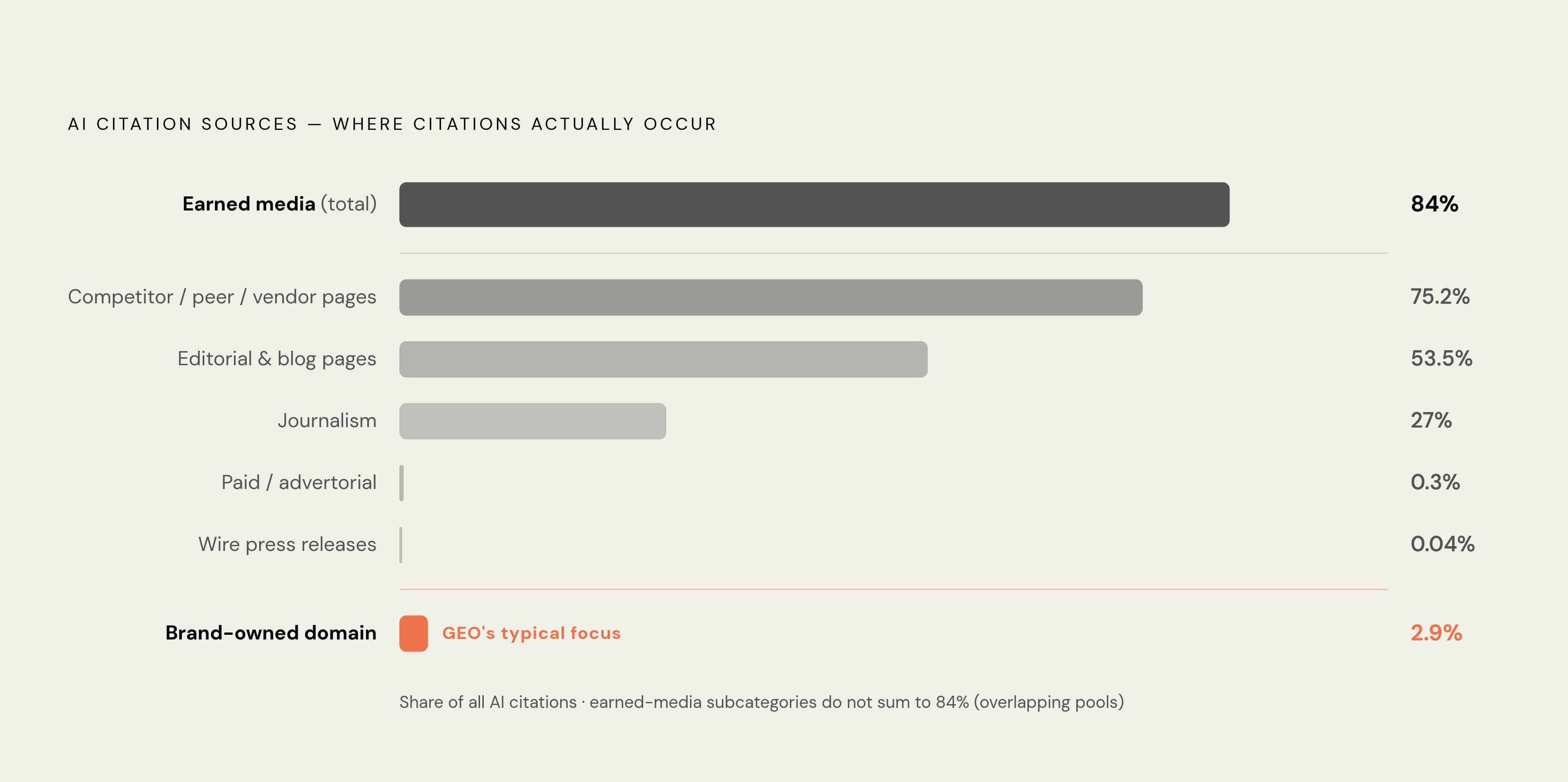
The single hardest fact for most marketing teams to absorb is that a brand's own domain is not where most of its citations will ever come from. Muck Rack's research, confirmed by a University of Toronto controlled experiment, found that 94% of AI citations trace back to non-paid, non-brand-owned sources⟦c31⟧, and that's not incidental noise, it's structural to how these systems weigh evidence⟦c31⟧. A follow-up analysis covering over 25 million cited links across ChatGPT, Claude, and Gemini in 17 industries put earned media at 84% of all AI citations, with journalism alone accounting for 27%⟦c32⟧. That finding held across three separate editions of the study between July 2025 and May 2026, landing between 82% and 89% through model updates and retrieval changes⟦c33⟧, which rules out the possibility that it's a fluke of one snapshot in time.
Ranqo's 2026 data sharpens the point further: only 2.9% of AI citations point to a brand's own domain, while 75.2% land on corporate pages owned by competitors, peers, and vendors in the same category⟦c34⟧. A GEO program built entirely around a brand's own site is optimizing for less than 3% of where citations actually happen⟦c34⟧. Format matters inside that earned-media pool too: editorial blog and content pages capture 53.46% of citations, while press releases distributed through wire syndication capture 0.04%, and paid or advertorial content captures 0.3%⟦c35⟧.
None of this means a brand's own site doesn't matter, or that owned content should get deprioritized. It means owned content's job changes: it needs to be good enough, specific enough, and structurally clean enough that journalists, forum contributors, and third-party sites want to cite it, because that's the channel that actually reaches the answer engine. Brands in the top 25% for web mentions earn over 10x more AI citations than brands in the bottom 25%, and brands with active third-party trust signals are cited in 75% of AI answers versus 1% without⟦c36⟧. Reddit illustrates the concentration this produces at the platform level, ranking as the number one or two most-cited domain across every major AI engine as of March 2026, with the top 15 domains capturing 68% of all consolidated citation share⟦c37⟧, a concentration well beyond anything Google's link graph ever produced. That share isn't fixed forever, either: Reddit's citation share in ChatGPT Search dropped sharply in mid-August 2026 for reasons that remain unconfirmed⟦c38⟧, a reminder that these platform dynamics move faster than any static content calendar can track.
Measurement has to follow the same logic. Tracking a brand's own domain performance in isolation misses the majority of the picture; tracking citation outcomes across engines, prompts, and earned-media placements over time is what actually shows whether a strategy is working⟦c19⟧. The properties worth building toward are the ones the evidence supports directly, including structural clarity so chunking produces coherent standalone pieces⟦c24⟧, verifiable specificity because statistics, quotations, and cited sources are the most empirically validated lever available⟦c39⟧⟦c27⟧, and a sustained publishing cadence rather than a one-time content refresh, since freshness and consistency compound the same way mentions do⟦c3⟧.
Sources
- AI answer-engine visibility becomes a measurable discipline as GEO platforms multiply in 2026
- Optimizing Visibility in Generative Engines: A Critical Survey of Generative Engine Optimization (2023-2026)
- Generative Engine Optimization: The Complete 2026 Guide | Similarweb
- How AI Search Engines Find, Summarize, and Cite Content
- How AI Answer Engines Decide Which Sources to Cite — and How to Become One
- AEO Playbook: Why 89% of AI Citations Come from Earned Media
- Generative Engine Optimization Statistics (2026): 60+ Data Points on AI Citations, Brand Visibility, and Content Performance
- Answer Engine Optimization (AEO) Statistics (2026): 55+ Data Points on Brand Visibility, Buyer Discovery, and Citation Rates