Personalization at Scale in Content Marketing
Most companies confuse segmentation with personalization and lose relevance in the scaling process.
September 23, 2026
Asking about Personalization at Scale first is the Wrong Starting Question
Content marketing keeps using a term it hardly questions: scaling up personalization. Most teams see it as plumbing: choose the tools, pump in information, and relevance comes out by itself. That framing avoids a deeper question: is what leaves the scaling process still personalization?
A Marigold blog post highlights a distinction many in marketing ignore. Segmentation sorts buyers using traits like demographics, geography, and clusters of earlier actions. Personalization, done right, fits an interaction or piece of content to one individual. These aren't positions on a shared dial, where more information slides you from one toward the other. They are distinct activities, resting on assumptions that define "relevant" in their own way.
Most companies really just do segmentation and call it personalization afterwards. Bluecore’s blog explains the mechanism: brands use segments to achieve relevance without making hard decisions about which product, promotion, content, or timing fits each individual. Segmentation makes a group feel a decision got made when nobody did.
That doesn't make the need fake. According to McKinsey, 71 percent of consumers want personalized treatment from brands, while 76 percent get mad when they miss out. That expectation drives "personalization at scale" to appear in nearly every content strategy deck written in the last five years.
Seeing how appetite for personalization gets tested narrows the field right away. The best proof shows up in buying situations: store purchases, online product suggestions, behavioral emails set off by an abandoned cart or a browsing session. The jump from "a recommendation engine lifts basket value" to "an editorial team should personalize every article it publishes" is a category error, and it's one the industry rarely says out loud, let alone defends with anything resembling evidence.
Start with a different question than how to scale personalization. It's whether individual-level personalization is even the right mechanism for what a content audience needs, and what "feeling understood" requires when there's no cart, no click-through, no transaction sitting there to optimize against. Settling the question has to happen before any tooling talk, not after.
Whether true personalization survives the scaling process at all
Most companies imagine Individual-level personalization one way, but scaling the process leaves it anything but intact. Editorial content like in-depth articles, opinion pieces, and videos feels this most strongly. What carries over is a close cousin that, built right, matters just as much: relevance built in, not personalization at every step.
The best counterargument should be taken seriously before it's dismissed. AI-driven tools can adapt content nearly person by person. Spinutech shows how owned info, behavioral tools, and AI mix to fit each buyer's path, shifting copy on the spot to guess what actions come next. It's real capacity, built on real infrastructure, not marketing talk cut off from technical work.
But that example is transactional. It needs dense behavioral signals, quick reactions, and a final sale to judge against. Editorial content marketing doesn't have any preconditions like those. Signals from one person stay weak, and the gap from putting out a thought leadership piece to observing any behavioral shift back can run for weeks. A 2026 research question remains open: do readers recognize AI-driven content as personalized, or simply as generic output from a broader template? The infrastructure for making per-segment versions has matured. It remains an open cultural question whether readers feel the output as personal or as a source of unease.
Privacy concerns push that limit down even more. A peer-reviewed Behavioral Sciences study points to YouGov research showing most respondents say personalized ads "creep them out," while Klaviyo found 21 percent of consumers are uncomfortable around AI... people say personalized ads "creep them out," YouGov research cited in a Behavioral Sciences peer-reviewed study says, while Klaviyo found 21 percent of consumers feel uncomfortable when AI seems too real or too familiar. That same Klaviyo research found that roughly one in five stop opening a brand's messages entirely after a poorly personalized send. The systems behind this personalization have worn down over time: cross-site tracking was cut off by standard in Safari starting in 2020, in Firefox during 2019, while Apple's App Tracking Transparency limited what apps could see even more. Regulators show no signs of easing, handing out over €1.2 billion worth of GDPR fines in 2025 alone.
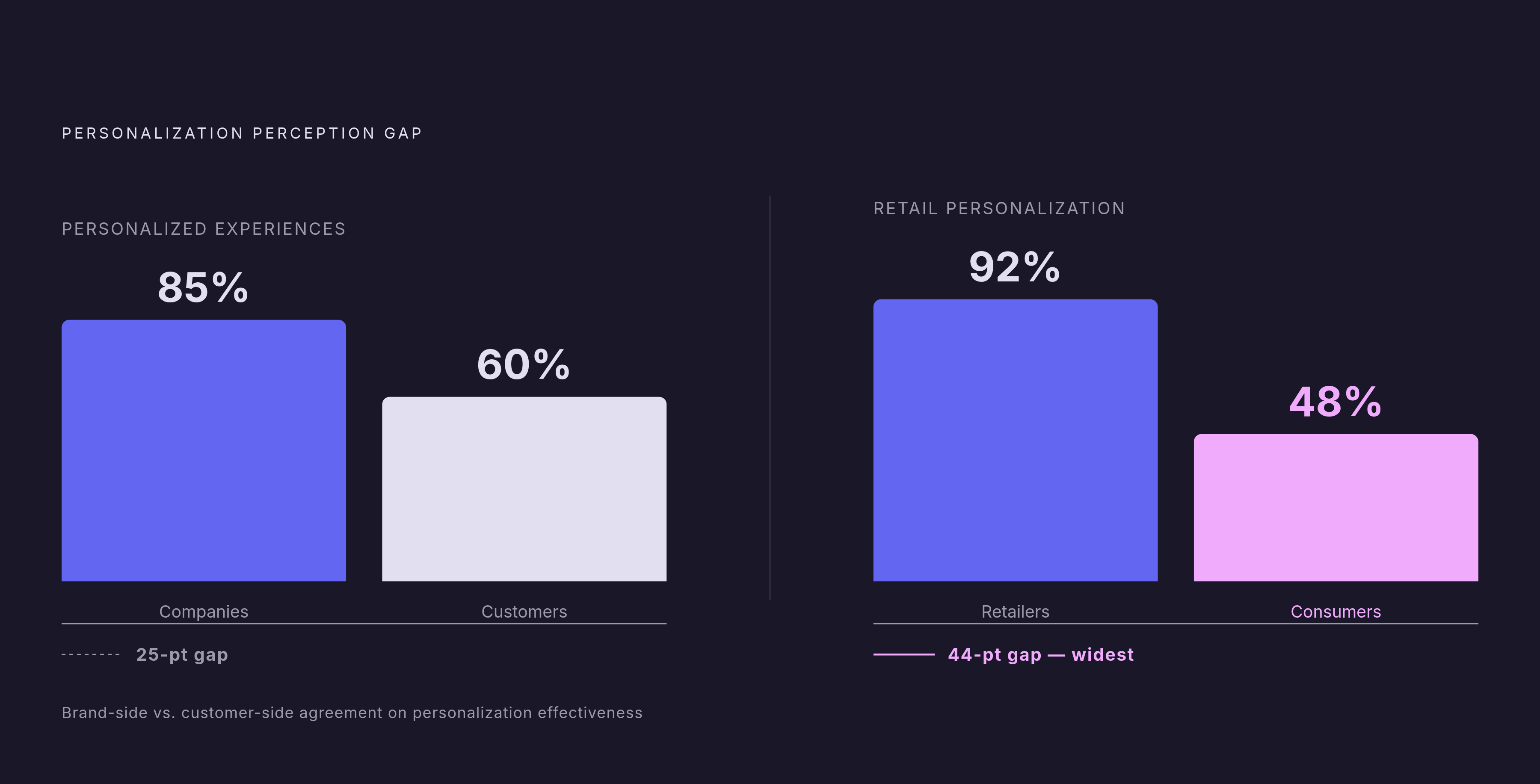
A Twilio Segment study puts the divide into two figures: 85 percent of companies say they offer personalized experiences, while just 60 percent of customers feel the same way. The 25-point gap puts it in miniature: brands expect one thing, while customers feel a structural mismatch.
Actions Content Marketing Teams Should Take
Drop the question of how personalization works at scale. Focus on how closely content gets built around one specific situation, since that improvement survives scrutiny, and it aims at situation and decision stage rather than job title or sector, which most teams slip into without noticing.
Most marketing still groups accounts by job function or sector, recent B2B surveys note that many teams label segmentation as personalization. A large share of ABM practitioners report they are still early in the journey, which shows how structural the aspiration-reality gap is here. Built into the system. Begin by checking each piece of content: can the team say which decision stage and specific situation it speaks to, or only the demographic behind it? If it’s the second, it’s segmentation, no matter the company label.
From there, content should be organized to match specific tasks and user goals, not broad audience types. A persona describes the reader. Situation design says what the reader is working through at this moment, and why it lands now instead of three months ago. Content mapped around the reader's situation produces relevance without individual-level details, because getting the match right replaces what those facts were meant to do. How a company sounds matters here too, as an advantage, not a mere stylistic afterthought. Industry reporting highlights that differentiation is regaining importance as generic content proliferates, with AI flooding content with material pulled from the same training sets and landing on the same conclusions. State of Marketing showed 56 percent of marketers say AI-generated content is everywhere online, while Many marketers observe that audiences increasingly detect AI-generated content, while demand for quick, tailored responses is rising. This paradox, where higher demands are colliding with degrading output, is the spot where distinctiveness earns its place.
Research suggests that successful brands maintain a consistent core message while customizing a smaller portion of their content. The brand tone remains the invariant. What changes is how that tone lands in a specific setting. Keeping that invariant safe matters more than output, and most teams miss this before they pick tools.
Get the order wrong and nothing holds up. Starting with personalization software before setting strategy leaves the split Deloitte reported: retailers at 92 percent said their personalization worked, but consumers did so at only 48 percent. Automation added to a solid strategy amplifies what's already working. Dropped in ahead of an unanswered question, it amplifies confusion at a scale no group could handle alone.