Semantic Search and Content Optimization Strategy
Search engines now reward intent and entity coverage, not keyword volume and phrase matching.
September 26, 2026
Most content teams still start with a bad question. They open a keyword tool, pull a volume report, and ask "what terms should we target?" That question made sense when Google matched strings of text against a search box. It doesn't hold up today. Google's Knowledge Graph contains 800 billion facts and 8 billion entities, and it processes more than 8.5 billion searches a day by mapping how those entities relate to each other, not by counting how many times a phrase shows up on a page. It no longer stops at matching text. Content work still needs to catch up.
What issue is the user entering this query trying to fix, and what must a company do wherever search and AI now surface results to win that spot? This calls for a new approach. A phrase isn't where it begins. It begins with someone and a problem.
That mismatch shows why content audits keep finding the same thing: pages that tick every on-page SEO box, drop the exact-match phrase into the title tag and opening hundred words, and still get stuck on page two, earning no traffic and no progress. What the page gives is often a mismatch with what the searcher wants. A keyword volume report shows how many people typed a search box phrase. You can't know whether people needed a guide of substantial length, side-by-side options, a calculator, or an explainer lasting five minutes. Volume is just a headcount. It doesn't show format or depth, or anything after the click.
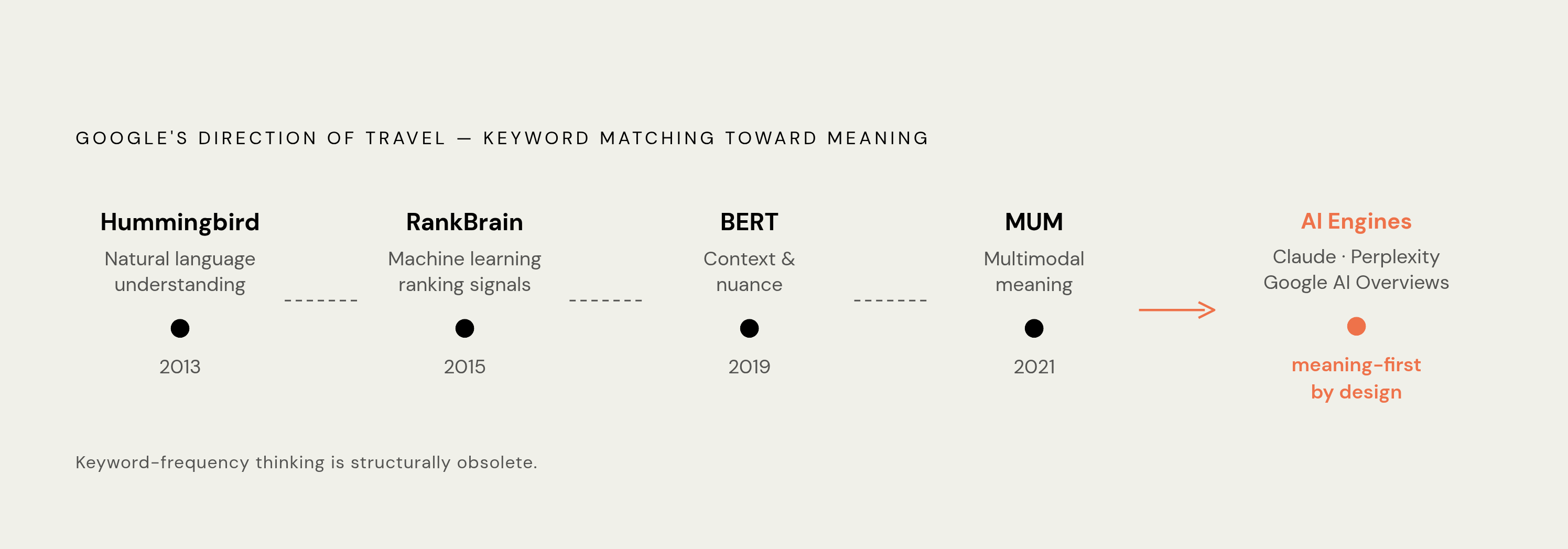
This is where the change in how search engines function genuinely bites. Google's shift from pure keyword matching came in stages. Over about ten years, Hummingbird (2013), RankBrain (2015), BERT (2019), and MUM (2021) each pushed search from string matching toward meaning matching. A page that accurately maps out entities and how they connect can now show up for queries it wasn't built around. A page built to chase one phrase gets capped there, and sometimes can’t even keep it.
AI engines inherited this same setup automatically. From day one, Claude, Perplexity and Google's AI Overviews have handled content by meaning, with no old SEO habits to shed. So the question for content teams is no longer about semantic search as something Google does. It comes down to whether a brand's content gets built on real subjects and entities, or on phrases that posted volume in a recent report.
The case for intent-led optimization over keyword coverage
Intent shapes what follows once a visitor clicks or chooses to skip the click. Someone searching "is SEO worth the investment" is deciding whether to hire an agency, and they're in evaluative mode: weighing costs, comparing outcomes, looking for proof. Anyone deciding whether to bring on outside help has entered an evaluative mode: weighing costs, looking for evidence, and comparing outcomes. A page using a glossary-style explainer for this query gets the topic right but loses the reader. Format and depth need to fit the searcher's mode.
This is a bigger deal now because of how search engines understand plain questions. Search engines now get that twelve queries worded in different ways can share the same intent. Optimizing a topic for each phrasing variant isn't needed now. Meeting the cluster's intent replaces the old manual keyword shuffling. Memorizing the broad intent taxonomy of informational, navigational, transactional, and commercial serves no purpose. Set the format before drafting starts to avoid the usual plan problem: mismatched depth, off content format, good topic, bad slant.
When done right, semantic keyword research is entity research. That is entity research. A page on email marketing strategy should mention A/B testing, open rate, and segmentation because those are the entities that actually belong to the topic, not because they're clever synonyms for "email marketing." Get the entity coverage right and keyword coverage tends to follow on its own. It only flows one way: satisfy intent and the ranking terms come as a byproduct, but go after ranking terms and intent won't come along on its own. People Also Ask results show this in practice. Ahrefs data shows 43% of searches now trigger a PAA box, and covering a topic well improves the chances of showing up in one, broadening what a page can rank for without going after any extra keyword.
The main objection here needs a proper response. Teams using keywords still place pages. Plenty of the content getting credited as a "semantic SEO win" is really just more comprehensive content, and thorough keyword research always recommended covering a topic broadly. True enough. Yet it conflates keywords, which still reveal what people want to know, with keyword frequency, a ranking lever engines left behind once they began matching intent rather than exact terms. Pages built around what users want still convert at smaller search numbers, since those visitors arrive ready for what they're shown. High-volume pages built in the wrong format draw visitors who leave right away, and that pattern itself hurts the page's rankings. Going after the largest figure in the volume report can mean it earns less than it's costing.
What this means for how brands structure and measure content
Brands now have to build a topic cluster; it's no longer optional. Topical authority, how much a search algorithm sees a domain as a comprehensive and trusted guide on a subject, is built with a pillar page on the broad topic, tied to subtopic pages that explore narrow angles and point toward the pillar. A WordPress SEO pillar might send readers to pages on SEO, schema markup, linking, content audits, and on-page optimization, with every subtopic page reinforcing trust across the cluster.
Most teams miss the research work of mapping each subtopic before anything goes live. Gaps in coverage signal missing knowledge. A search system evaluating a page’s trust on a topic expects every key query answered, not 20 articles that leave out three points any specialist would include. A research pass using People Also Ask, similar searches, and a review of what competitors include or skip is required: broad covers many surfaces, comprehensive goes through every important angle of one subject in true depth, and search engines now spot that gap.
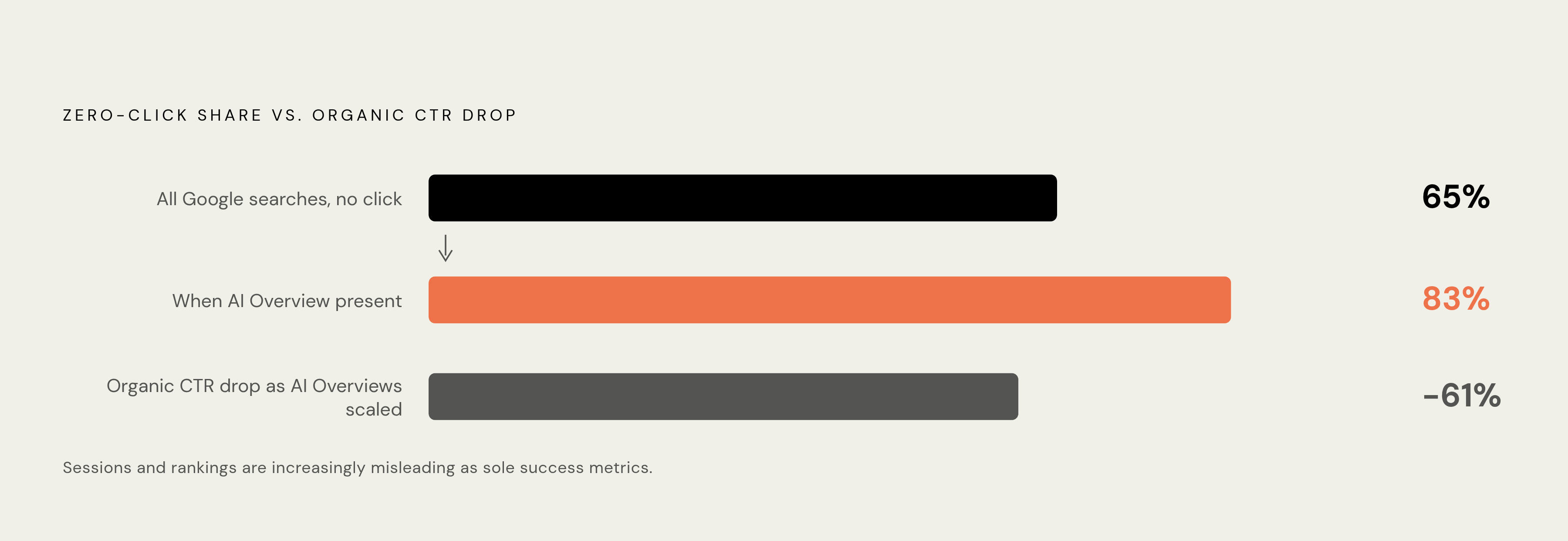
This gets harder when teams assess content, especially early in the funnel. Today, roughly 65% of all Google searches end without a click to any external website, and if the results page includes an AI Overview, that share climbs to 83%. As AI Overviews appeared more frequently, organic click-through rates declined 61%. In practice, informational content built around "how to" and "what is" topics functions now as a citation rather than a visit driver. Judging that content by traffic numbers means tracking a metric that's shrinking due to platform changes, not performance issues.
Getting a mention within an AI response and appearing as a standard entry on a results page aren't equivalent outcomes, so analytics must account for that difference. So teams should include entity coverage and citation visibility in the dashboard that only reports sessions and rankings, even as AI citations data stays incomplete. Organizing pages around core topics and related ones is the best bet content teams have in search, where people hardly ever visit sites anymore. That is content teams' nearest hedge in a search landscape in which the click itself is the exception rather than expected.